guides
Manual vs Battery vs Pneumatic Strapping Tools: Which to Choose (and the Step They All Miss)
A clear comparison of manual, battery and pneumatic strapping tools by speed, cost and use case — plus the one part of the job no hand tool does, no matter how good it is.
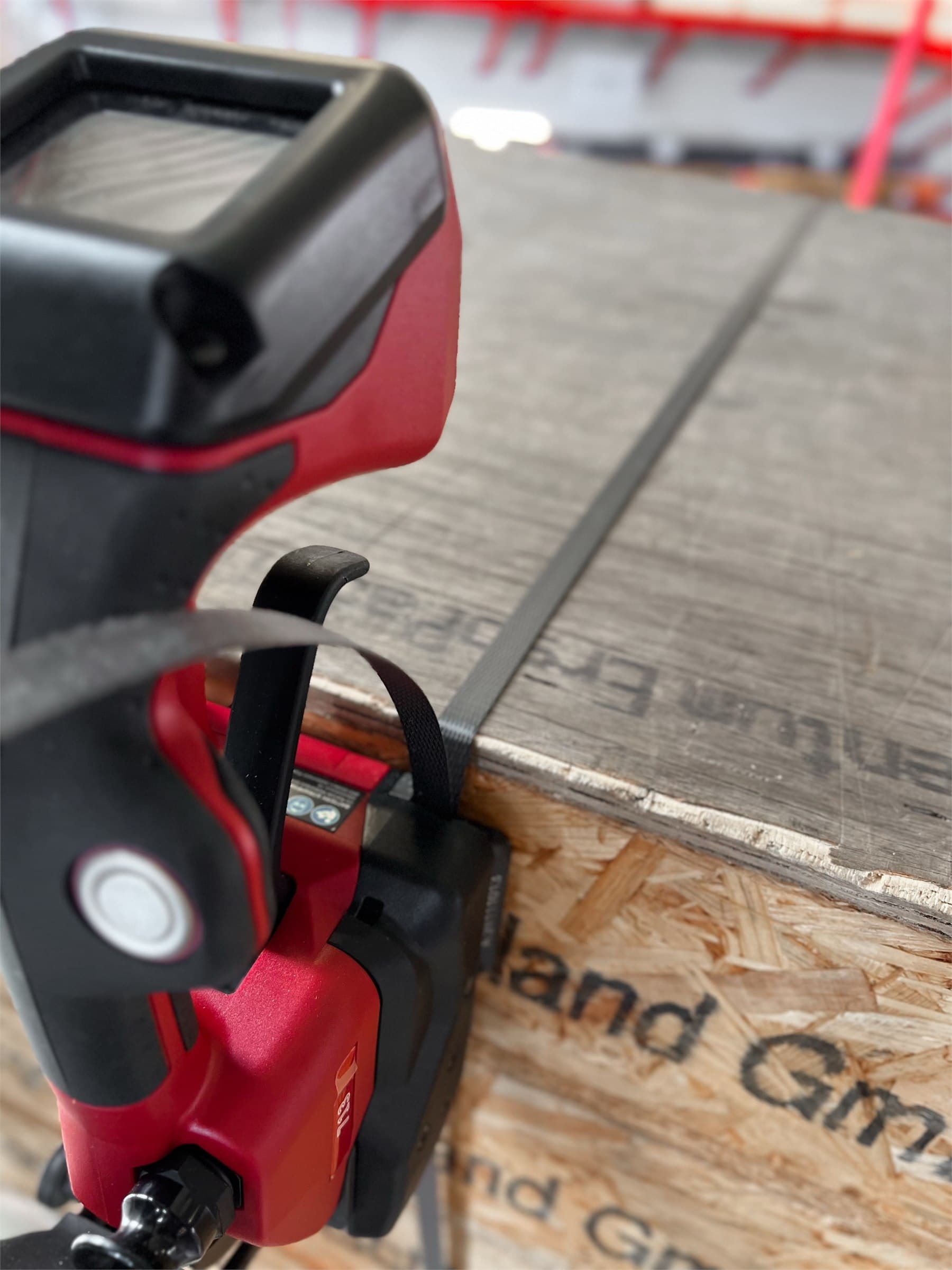
If you strap by hand, the tool you use decides your speed, your consistency and your cost. But there is a catch that the tool comparison never mentions: every hand tool, however advanced, only does the last part of the job. We will cover the comparison first, then the part that matters most.
The three types of strapping tool
Manual strapping tools
A separate tensioner and sealer, operated by hand.
- Pros: lowest upfront cost; simple; no power or air needed.
- Cons: slow; tension depends entirely on operator strength, so it varies; higher labour cost over time.
- Best for: low volume, occasional strapping, light loads.
Battery-powered strapping tools
A combined tool that tensions, seals and cuts in one trigger, powered by a rechargeable battery.
- Pros: fast; adjustable, repeatable tension and automatic sealing; portable with no air line; quieter; low maintenance.
- Cons: higher upfront cost than manual; battery management.
- Best for: medium-to-high volume PP/PET strapping where consistency matters.
Pneumatic strapping tools
Air-powered tools driven by a compressor.
- Pros: fastest cycle; very robust and heavy-duty; ideal for the highest-volume, toughest applications.
- Cons: needs a compressor and air lines (tethered, less mobile); noisy; more infrastructure.
- Best for: high-volume, heavy-duty, fixed stations.
Quick comparison
| Factor | Manual | Battery | Pneumatic |
|---|---|---|---|
| Speed | Slow | Fast | Fastest |
| Tension consistency | Variable (operator) | Repeatable | Repeatable |
| Mobility | Full | Full (no air line) | Tethered to compressor |
| Infrastructure | None | Charging | Compressor + air |
| Noise | Quiet | Quiet | Loud |
| Upfront cost | Lowest | Mid | Higher |
| Best volume | Low | Medium–high | High |
Which should you choose?
- Low volume / light loads: a manual tool is fine.
- Medium-to-high volume, mobile: a battery tool — speed and consistency without an air line.
- Very high volume, fixed, heavy-duty: pneumatic.
For most modern Indian dispatch floors, a battery PET tool is the sweet spot.
The step every hand tool misses
Here is what the comparison leaves out. A strapping tool — manual, battery or pneumatic — only tensions and seals. It does nothing about the slowest part of strapping a pallet: getting the strap under and around the pallet in the first place. With any hand tool, an operator still has to push the strap under the load by hand (the "broomstick method"), walk around the pallet, and feed it back — roughly the first 115 seconds of a ~120-second manual cycle. The tool only handles the last few seconds.
That is why upgrading the tool gives diminishing returns once you have a good battery sealer: the bottleneck is the routing, not the seal.
Automating the part that actually costs time
The bigger gain comes from automating the strap routing, not just the seal. A mobile ChainLance routes the strap under the pallet and back to the operator automatically — and you keep using your existing tool, or switch to a fully integrated head:
- The ErgoPack 700 (manual crank) and ErgoPack GO (electronic) route the strap automatically and let you finish the seal with your existing battery or pneumatic tool — so your tool investment is not wasted.
- The ErgoPack 726X adds an integrated friction-weld head and digital tension if you want to replace the tool entirely.
This is the difference between a faster tool and a faster process. The full case is in our guide on going beyond manual hand tools.
Choosing your tool — quick checklist
- Volume low → manual; medium/high → battery; very high/heavy → pneumatic
- Need mobility without an air line → battery
- Running PET on heavier loads → battery or pneumatic, not manual
- Remember: the tool only seals — routing the strap is the real bottleneck
- For the big gain, automate the routing and keep your tool
The right hand tool makes the seal faster. Automating the routing makes the pallet faster — which is the number that shows up at the dispatch dock.
Talk to a pallet strapping engineer
BENZ Packaging and ErgoPack India engineers support installations and service anywhere in India. Tell us your pallet setup and we’ll recommend the right machine — and send pricing.
Related Reading
Continue with the next guide
guides
PP vs PET Strapping: Which Should You Use, and When?
PP and PET strap suit very different loads. A clear guide to when polypropylene is enough and when polyester is essential — by load weight, settling, and export exposure.
guides
Strapping Machine AMC, Spares and Uptime: What to Check Before You Buy
A strapping machine is only as good as its uptime. What to check on service, spare parts and AMC before you buy — so the machine that saves you ₹25 lakh a year actually keeps running.
guides
Pallet Strapping Machine Buying Checklist: 10 Questions Before You Decide
Before you buy a pallet strapping machine, run through these ten questions. They cover loads, volume, power, tension, service and ROI — so you choose the right machine, not just the cheapest.