insights
E-Commerce Order Fulfilment: How to Speed Up Dispatch Without Adding Headcount
The e-commerce fulfilment process explained — receive, store, pick, pack, ship — with the slotting, picking and dispatch strategies that lift speed and accuracy, and the outbound bottleneck most miss.
E-commerce lives and dies on fulfilment speed and accuracy. A fast, correct dispatch wins the repeat order; a slow or wrong one loses the customer and triggers a return. The good news: most of the gains come from process, not more people. Here is the fulfilment process and where the real speed is found.
The five steps of order fulfilment
- Receiving — accept and inspect incoming stock.
- Storage — organise products for fast retrieval.
- Picking — select the right items for each order.
- Packing — securely package for shipment.
- Shipping / dispatch — label, manifest and hand to the carrier on time.
Speed and accuracy are won or lost across all five — but mostly in how well each is standardised and verified.
Storage and slotting
Slotting places items to minimise picking travel: high-demand items go in the most accessible locations, sized and weighted for fast retrieval, and reviewed regularly as demand shifts. Good slotting alone removes a large share of wasted picking time.
Picking strategies
- Zone picking — workers own a zone, cutting travel.
- Batch picking — pick the same item across many orders in one trip; a powerful way to lift throughput without adding people.
- Discrete picking — one order at a time for accuracy on complex or high-value orders.
Accuracy: the 99.5% benchmark
The best operations ship 99.5%+ of orders without error, using barcode scanning, pick validation and packing checks through a WMS to verify the right item is picked and packed. Accuracy is not a personality trait — it is a verified, standardised process.
Dispatch: the outbound bottleneck
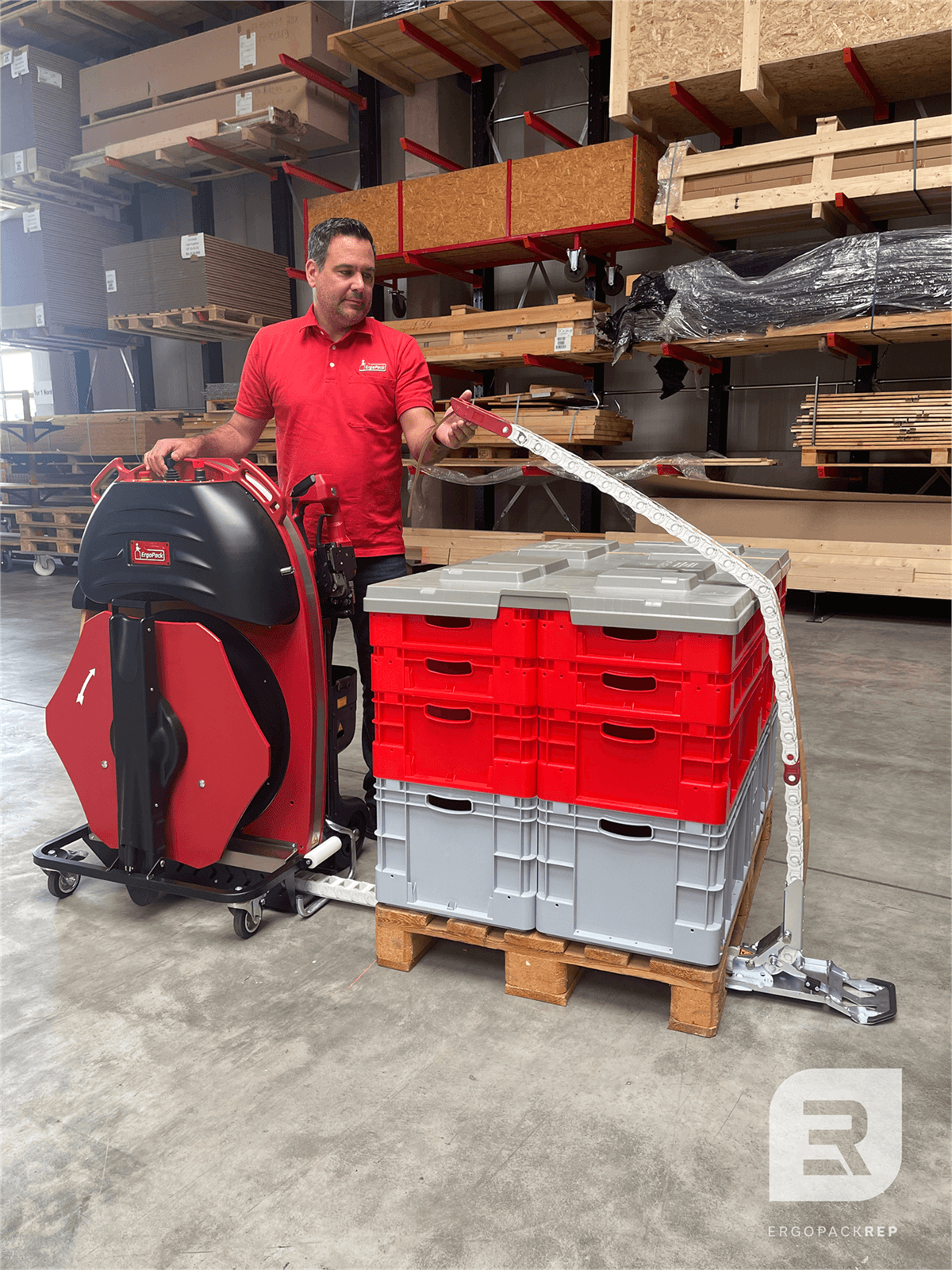
Here is where fulfilment speed is often quietly lost. The dispatch step — aligning packed orders to transport, labelling, manifesting, and building and securing outbound pallets for the carrier — is the last gate before the order leaves. When picking and packing run fast but outbound pallet build-up is manual and slow, finished orders queue at the dock and the whole operation's speed is capped by its slowest, last step.
For operations that consolidate orders onto pallets for LTL or store delivery, securing those outbound pallets is part of dispatch — and doing it manually (two operators, ~120 seconds a pallet) throttles the dock exactly when volume peaks.
Speeding up dispatch without more headcount
The theme across every fulfilment guide is the same: lift throughput through process and automation, not more hands. At the dispatch dock that means automating the outbound securing step:
- Cuts pallet securing from ~120 seconds to under 40, and from two operators to one.
- Clears the outbound queue so carriers load on time.
- Frees that labour back into picking and packing — the gain realised at the step that was capping output.
Mobile systems such as the ErgoPack 726X, GO and 700 do this at the dock with no conveyors or rebuilds. The broader case is in improve warehouse dispatch productivity and the financials in the ROI calculator.
Fulfilment speed checklist
- Slotting reviewed — fast movers most accessible
- Picking strategy matched to order profile (zone/batch/discrete)
- WMS scanning + pick/pack validation for 99.5%+ accuracy
- Each step standardised and verified, not improvised
- Outbound pallet securing automated so dispatch never queues
- Throughput lifted by process + automation, not headcount
Fix the process, verify every step, and automate the outbound bottleneck — and orders ship faster and more accurately with the team you already have.
Talk to a pallet strapping engineer
BENZ Packaging and ErgoPack India engineers support installations and service anywhere in India. Tell us your pallet setup and we’ll recommend the right machine — and send pricing.
Related Reading
Continue with the next guide
insights
Improving OEE: Why the Dispatch Dock Is the Forgotten Factor
OEE programmes obsess over the production line and ignore the dispatch dock — yet a manual securing bottleneck there caps the throughput your OEE is meant to protect. Here’s the link.
insights
Pallet Strapping Machine for Small Business: Is It Worth It?
Small and mid-size Indian manufacturers and exporters often assume automation is only for big plants. For pallet securing, that’s usually wrong — here’s why a mobile machine fits a small business.
insights
How Many Pallets a Day Justify a Strapping Machine?
There’s a simple volume threshold above which a mobile strapping machine pays for itself. Here’s how to work out yours — and why it’s lower than most people expect.